You are three weeks from a grocery chain’s cake launch and you are holding two quotes for the same plastic cake can at 11 p.m. One supplier offers a 330 ml body with a PP screw cap at a 200-piece minimum. The other quotes a 202-finish can with an aluminum easy-open end at 1,000 pieces. Neither quote states the body wall gauge, and that is the number that decides whether the cake reaches the counter intact or collapses on the pallet.
The obvious move is to take the lower unit price. That comparison breaks down because these are two different products: one is a lidded tub a bakery fills by hand, the other is a sealed can that needs a closing machine. Packaging Dive reported on October 28, 2026 that Smurfit Westrock expects a $700 million cost-inflation hit in 2026 and has pushed price increases through to offset it. Material and freight move the same way on PET, so the cheapest quote is usually the one with the thinnest wall and the fewest cans per pallet.
Below is the reference table our quoting desk works from: capacity, can finish, lid format, MOQ, lead time and end use, one row per size we mold. Then we take the three decisions that move a launch date, compare PP caps against aluminum ends, and list what each buyer type should order first.
Plastic Cake Can Reference Table: Capacity, Can Finish, Lid Format, MOQ and Lead Time
One row per capacity we hold tooling for. When you compare our sheet against another supplier’s, match on can finish and MOQ before you compare unit price.
| Capacity | Can finish / body | Material and lid format | MOQ | Lead time | Typical end use |
|---|---|---|---|---|---|
| 200 ml | 202/206 can finish | PET body + aluminum easy-open end | 1,000 pcs | 15–25 days | Tasting portions, sample-size cake |
| 210 ml | Straight wall | PET body + PP cap | 200 pcs | 15–25 days | Mousse, cream cups, parfait |
| 250 ml | Straight wall | PET body + PP cap | 200 pcs | 15–25 days | Single-serve cake, tiramisu |
| 330 ml | Straight wall, flat / dome / easy-open lid | PET body, multiple lid options | 200 pcs | 15–25 days | Standard cake can, cafe retail |
| 500 ml | Straight wall, flat / dome / easy-open lid | PET body, multiple lid options | 200 pcs | 15–25 days | Two-portion cake, bakery counter |
| 650 ml | Straight wall | PET body + PP cap | 200 pcs | 15–25 days | Family cake, large tiramisu |
| 1000 ml | 202/206 can finish | PET body + aluminum easy-open end | 1,000 pcs | 15–25 days | Bulk dessert, export pallets |
Read the finish column first, because it tells you what equipment you need in the building: a capper for the 210 ml to 650 ml range, a seamer for the 200 ml and 1000 ml cans. MOQ splits the same way. Everything we mold on the straight-wall cake molds starts at 200 pieces; the aluminum-end sizes start at 1,000 because they run on a separate seaming and packing line. Lead time is 15 to 25 days across both, and every size on this sheet is rated -30°C to 60°C.
The 330 ml Plastic Cake Can: Where Body Wall Gauge Sets the Case Count
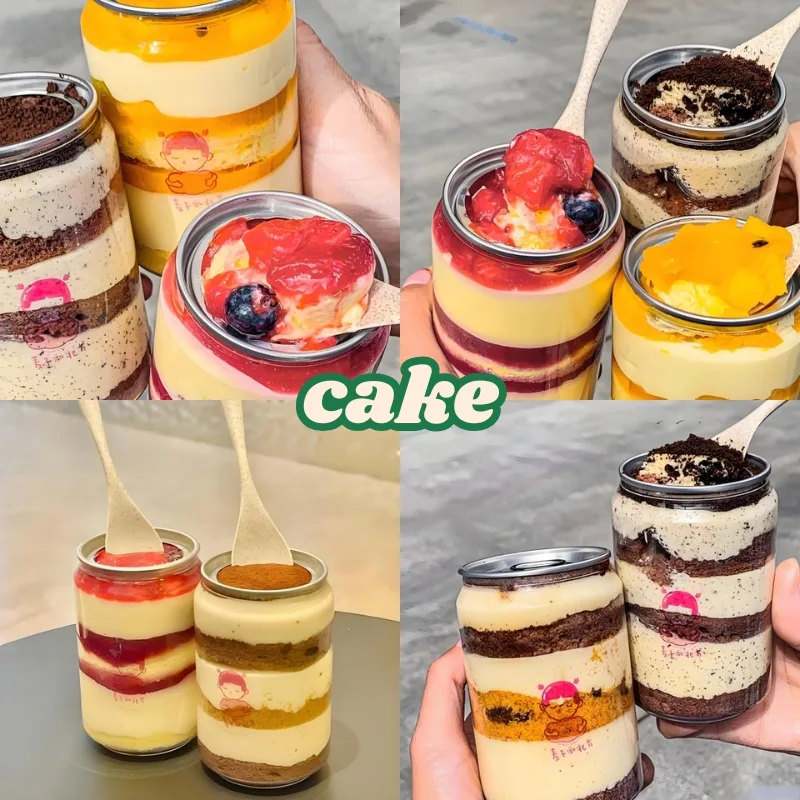
Most of the cake programs we quote land on 330 ml or 500 ml. A four-inch layer cake, a tiramisu, a mousse ring all fit a 330 ml body, and 330 ml keeps a case count sensible on a grocery shelf. Buyers usually specify the lid color and the label area first, because that is what the mock-up shows them.
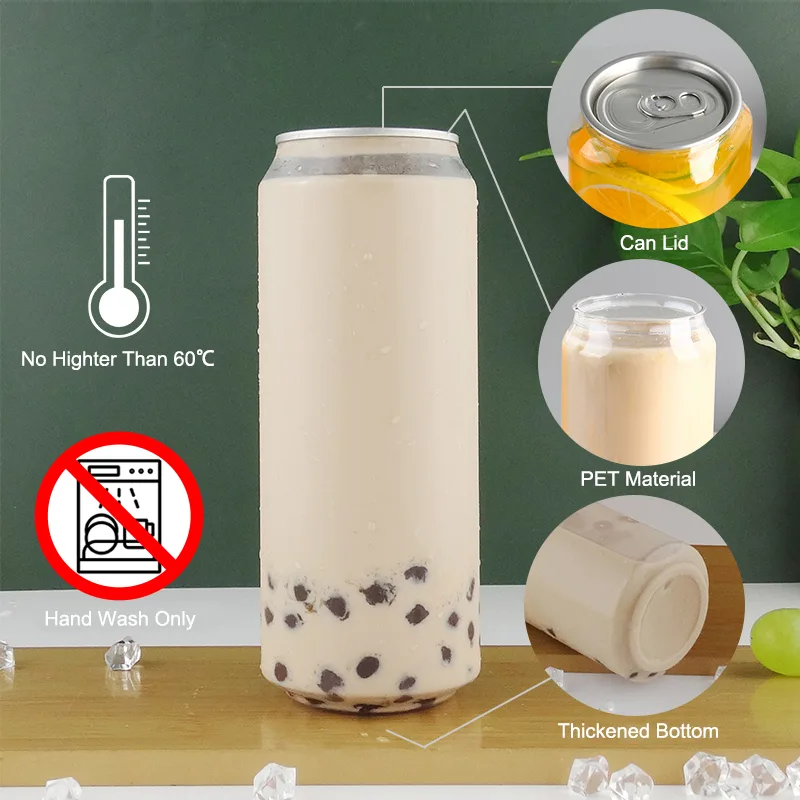
The parameter that decides whether the format works is the body wall gauge. A PET cake can carries load through its sidewall when cases stack, and a wall cut to save resin will ovalize under a two-pallet stack in a warm trailer. We hold our wall gauge across the full body length instead of thickening only at the neck, and our QC crew checks it with a micrometer at the start of every shift on that mold. The transparent PET cake can we mold at 330 ml and 500 ml takes flat, dome or easy-open lids, and the body runs -30°C to 60°C, which covers freezer, chilled cabinet and a summer truck.
The mistake we see most is a buyer taking the thinnest wall on the quote, then repacking from 12-count cases into 24-count to save freight. A wall that survived a single-layer pallet will not survive a double stack. Send us the stack height and the trailer temperature and we will tell you which gauge to hold. Ask for that gauge in writing on the quote; a supplier who will not put a number on paper is selling you a wall, not a spec.
202/206 Can Finish: The Lid Decision That Sets Shelf Life
A shelf-stable cake needs a sealed can, not a lidded tub. That means a 202 or 206 can finish and an aluminum easy-open end, double-seamed on a closing machine. Ambient cake, export pallets and anything that sits in a distributor’s warehouse for two months belong in this format. A counter cake that sells out in four days does not.
The can finish is the deciding parameter, and the detail buyers miss is that a 202 end and a 202 body still have to match on seaming chuck and roll profile. We build the sealing machines that close these cans, so we set the end and the seam specification together instead of buying them from two catalogs and hoping they meet on your floor. Our seamer and our can mold are held to the same numbers.
The common mistake is ordering 1,000 cans and then discovering the co-packer’s rotary seamer takes a different end diameter. Get your filler’s seamer spec in writing before you pay a deposit, or ask us to send a sample seamed on our machine and forward it to them. Our clear PET plastic can range covers 200 ml to 1,000 ml in eight sizes on standard 202/206 finishes at a 1,000-piece MOQ.
From MOQ 200 pcs to 1,000 pcs: Matching the Order to the Launch Window
Our 210 ml to 650 ml bodies run at a 200-piece minimum because those molds are already cut and on the rack. The 200 ml to 1,000 ml aluminum-end range runs at 1,000 pieces because those cans are seamed and packed on a separate line. If you are testing a flavor or chasing one retail account, take the 200-piece lot, run it through your own filling step, and keep the cash for the reorder.
Lead time is 15 to 25 days on PET cans. Caps and closures run 20 to 30 days on their own schedule, and that gap is where launches slip. A buyer places the can order, assumes the lids ship with it, and learns a week later that the caps are still on the closure line. Put both on one purchase order and confirm the dates together.
The second mistake is ordering retail-ready cases for a trial. On a 200-piece run we ship nested bodies with lids bagged separately, which cuts freight volume and lets you label locally. Printing, color matching and logo work need the full lead time, so book those before you book the launch date. The custom clear PET dessert can covers 210, 250, 330, 500 and 650 ml in a PET body with PP cap at that 200-piece minimum.
PP Cap vs Aluminum Easy-Open End: Choosing the Plastic Cake Can Format
Two formats come up in almost every cake quote we write, and they are not interchangeable. One is a PET body with a molded PP cap in the 210 ml to 650 ml range. The other is a 202/206 can with an aluminum easy-open end in the 200 ml to 1,000 ml range. Food Dive reported on October 29, 2026 that Hershey expects consumer financial stress to weigh on Halloween sales, and dessert brands are launching into the same price-sensitive shopper. The closure is one of the few line items you can still engineer down without touching the recipe.
| Decision factor | PP cap, 210–650 ml body | Aluminum easy-open end, 200–1,000 ml body |
|---|---|---|
| Cost per unit | Cheaper closure; cap molds already held | Higher lid cost, plus a seamer in the building |
| Fill and seal compatibility | Hand or automatic fill, cap torqued on, reopens for a tasting counter | Needs a closing machine and a double-seam check, does not reopen |
| Lead time | Cans 15–25 days, closures 20–30 days on a separate schedule | Cans and ends 15–25 days on one order |
| Tooling | Body molds cut for 210–650 ml; cap tooling on our closure line | Seaming chuck and rolls must match the end diameter |
| Leak and breakage risk | Cap torque decides; a loose cap leaks in a chilled cabinet | Seam decides; a bad seam fails slowly and quietly |
For a chilled cake sold through your own counter or a local grocery account, choose the PP cap on a 210–650 ml body. For ambient-stable cake, export pallets, or anything that must survive a distributor’s warehouse, choose the aluminum easy-open end on a 202/206 can.
What Bakery Brands, Co-Packers and Importers Should Order First
Cake and Dessert Brands
Start with 200 pieces of 330 ml, flat lid, unprinted. That gets your recipe, fill weight and label through a real retail test without committing resin to a design you may change. Before the deposit, ask for the wall-gauge reading and the cap torque spec on the sample and put both on the purchase order. Check the temperature range against your worst case: our cans are rated -30°C to 60°C, so a freezer-to-counter move sits inside spec and a hot delivery van sits at the edge.
Co-Packers and Fillers
Order the format your closing equipment already runs. If you seam aluminum ends, take 1,000 pieces of the 202/206 range and ask for sample seams to travel with the delivery. If you fill and cap by hand, take the 210–650 ml PP-cap bodies and confirm the cap diameter against your existing capper before you order. Before paying, get the can finish and the end diameter onto one document and check both against the tooling on your floor. A mismatch there costs more than the cans.
Importers and Distributors
Order by the pallet, and specify nested bodies with lids bagged separately to cut volume. Ask for the case pack, pallet pattern and gross weight before you book freight, because PET cake cans cube out long before they weigh out. Before the deposit, line the closure lead time of 20–30 days up against the can lead time of 15–25 days and make sure both land on the same shipment. Verify the can finish on the sample, not on the brochure.
On Our Line: Molds, Molding, Closures and the Seamer
The cake-can bodies come off our own molds, which we cut and maintain in-house. We run injection blow molding for the 210 ml to 650 ml straight-wall bodies and for the 200 ml to 1,000 ml aluminum-end range. PP caps come off our closure line. Aluminum ends are sourced to the 202/206 finish we specify and checked against the seaming chuck on our closing machines before a run starts.
Every run walks the same steps: body wall gauge with a micrometer at shift start, dimensional and visual check on the finish, cap torque or double-seam measurement depending on the format, a leak test on samples pulled from each batch, then packing. Our can sealer build and our can line share seam specifications, so the machine we ship and the can we mold are set to the same numbers rather than to two suppliers’ guesses.
What you can verify on the sample we send: measure the body wall at three points with a micrometer, check cap torque with a torque gauge, and if it is a sealed format, cut a seam and look at the cross-section. Your first order ships with the wall-gauge reading, the closure specification and the packing list, plus the seamer manual when a machine is on the order.
Key Takeaways
- Specify the body wall gauge, not the diameter. Diameter decides what fits on the shelf; wall gauge decides whether the case survives a two-pallet stack in a warm trailer.
- Match the can finish to your filler’s equipment before you order. A 202 end and a 202 body still have to agree on seaming chuck and roll profile, so get your co-packer’s spec in writing.
- Take the 200-piece lot before the 1,000-piece lot. Our 210–650 ml molds are already cut, so a trial costs you resin, not tooling.
- Put cans and closures on one purchase order. Cans run 15–25 days and closures 20–30 days, and that gap is where launch dates die.
- Pick the lid by shelf life, not by looks. PP cap for chilled counter cake, aluminum easy-open end for ambient or export, and never the reverse.