Let’s start with the numbers, because they’re kind of wild.
Mordor Intelligence puts the global PET beverage packaging market at $79.62 billion in 2026. They’re calling for $103.68 billion by 2031 — a 5.56% CAGR. Future Market Insights goes even broader, pegging the total PET packaging market at $93.3 billion this year, headed toward $144.9 billion by 2036 at 4.5% annual growth.
Translation: transparent plastic packaging isn’t a trend. It’s a freight train, and it’s picking up speed.
So why is glass losing?
Look, nobody denies glass looks premium. But it’s heavy — a 330ml glass bottle weighs about 200 grams. A PET can of the same volume? Less than 29 grams. That’s nearly a 7x difference.
That weight gap hits your shipping bill like a sledgehammer. Ship a container from Asia to Los Angeles, and glass will cost you 40% to 70% more in freight than PET. Run the math on half a million bottles and the shipping delta alone eats your entire margin.
Then there’s breakage. Glass loses 3% to 5% in transit — that’s just an industry fact everyone quietly accepts. PET cans? Under one-tenth of one percent. If you’re doing DTC e-commerce, this difference is the line between making money and writing off inventory.
Why not aluminum?
Aluminum cans are light. No argument there. But they’ve got one dealbreaker: you can’t see what’s inside.
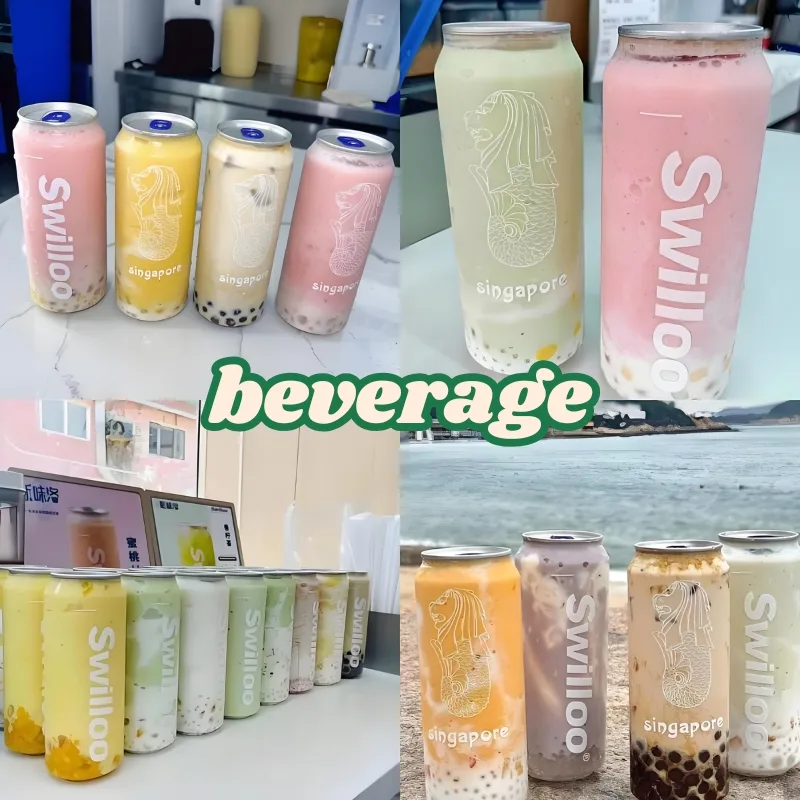
There’s a clear consumer shift happening in 2026 — people want to see the product before they buy. The deep amber of cold brew concentrate, the layered gradient of a sparkling fruit drink, the boba pearls suspended in milk tea… these are purchase triggers. Hide them behind opaque aluminum and you’re fighting with one hand tied behind your back.
Industry research backs this up: transparent packaging can boost purchase intent by up to 30%. For visually-driven products, that 30% isn’t a nice-to-have — it’s survival.
And here’s another data point worth knowing: the transparent rPET beverage market alone is valued at $7.86 billion in 2026 and projected to reach $18.44 billion by 2036, growing at an 8.9% CAGR. The market isn’t just voting for transparency — it’s sprinting toward it.
Which categories are sprinting toward PET cans?
Our own shipment data lines up pretty well with what the market is telling us:
-
Bubble tea / RTD milk tea: The single hottest category of 2026. Global bubble tea market hit $2.99 billion this year with a 9.56% CAGR. These drinks are moving from street-side shops to supermarket shelves. Consumers want to see those pearls, coconut jelly cubes, and pudding bits. Nobody’s buying a can of mystery milk tea.
-
Cold brew coffee: The color is the quality signal. Deep brown says bold and intense, light amber says smooth and mellow. A transparent can turns your product’s appearance into free advertising.
-
Fresh-pressed / HPP juice: Pulp, hue, freshness — all three matter, and all three shine through clear PET.
-
Functional beverages: Electrolyte drinks, protein shakes, meal replacements — consumers want proof there’s substance in there, not just colored water.
Sports and functional beverages are growing at 8.21% annually, the fastest-moving segment in the entire beverage packaging space. And they’re overwhelmingly choosing clear.
The sustainability angle nobody’s talking about
Here’s something your CFO will care about: rPET’s carbon footprint is 79% lower than virgin PET. With the EU’s PPWR taking full effect August 12, 2026 — requiring 30% recycled content in PET beverage bottles by 2030 and 65% by 2040 — the writing’s on the wall. Brands that get ahead of recycled content mandates now won’t be scrambling later.
Coca-Cola saw this coming years ago. They switched Sprite from its iconic green bottle to clear PET specifically to improve recyclability. When the world’s biggest beverage company makes that call, it’s worth paying attention.
The bottom line
If your beverage is still in glass or aluminum, ask yourself one honest question: is this choice because it’s genuinely the best fit for your product, or because “that’s how everyone does it”?
PET cans handle internal pressures up to 90 PSI — so carbonated drinks are on the table. They’re FDA-compliant. They ship cheaper, break less, and sell better because customers can see what they’re buying. The math isn’t complicated.
At CHINPK, we’ve been making PET cans for 17 years. From 5,000-unit trial runs to full-container export orders — FDA-compliant, food-grade materials, aluminum easy-open ends, the works.
Browse our cans, or let’s talk about what packaging fits your product. No pressure — let’s just see if this makes sense for you.